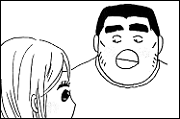
I know I've become long obsessed with analyzing this manga, but I remember the time when I was reading Kenji Sakaki's Enigma. At chapter 35, a new character was introduced in a flashback, only to be revealed a mere five chapters later to be the true antagonist behind everything that's happened to the protagonists. Given the lack of timing between these two events, the reveal felt very obvious when it came up.
Here, Matsui's pulls off about the same thing, except even MORE blatantly than Kenji Sakaki, and yet it works significantly better.
I say the reason for this is because it wasn't meant to be a reveal in the typical manner of being unexpected. Rather, this reveal relies on reader disbelief that we've truly seen this character already, absolutely NOT so long ago. We all knew he was crazy for trying to instill a regime for training the students of class 3-E while trying to maintain a happy composure, but once the class takes their summer vacation and the slightest hint of his involvement is implied, for the next while, we've been left to ask ourselves:
- Is this truly the same guy already?
- Is he really plotting on MURDERING the students he was just trying to bond with, no matter how forcefully?
- Did he really just associate himself with all these criminals in such a short period of time?
- All in all, is he even capable of taking this to a whole new level of crazy after all the stuff we've seen him do already?
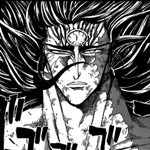
We see the silhouettes really resemble this guy, and yet we've only seen him run off like a wuss not so long ago, so it's definitely left some doubt and suspense to the readers as to whether the silhouette truly is Akira Takaoka, and whether he truly developed his craziness at such a magnitude. In other words, although it's an obvious fact Akira Takaoka is crazy, the stark contrast from when we've last seen him and the lack of timing afterwards made this particular reveal more impacting than it should've been.
Compare that to the relatively lacklustre Enigma. First of all, the flashback at chapter 35 just came at random after the last protagonist's talent was revealed. It had no purpose other than to contrive a reason as to why her talent appeared so late into the story, and to introduce someone who can't POSSIBLY be Enigma *sarcasm*. I mean, as readers, our first impression of Kirio is a quiet guy who shows little to no emotion and appears very dark, in particular from his clothes, hair and facial expressions. That is exactly the kind of appearance an antagonist with a troubled past would portray, because as readers, we can already identify these warning signs and deduce that this "friend" is up to no good and probably has some screwed up thoughts in his minds. Heck, the chapter even says he went through some "trauma". Once chapter 40 came along, it didn't really surprise us that Enigma was actually him, ESPECIALLY since Kenji Sakaki only gave us ONE chapter to learn about him, a contrived, rushed background that readers just can't connect with, which she only expanded AFTER his reveal. By then, it would already be too late to captivate the readers, thus contributing to the ad hoc nature of this manga and its eventual downward spiral. To summarize, a personality acting as a likely predecessor to the personality of an unknown antagonist does not make a satisfying reveal for the latter's identity when combined with a lack of timing.
Don't get me wrong, I still loved Enigma for what it had, and I'd love to see Kenji Sakaki come back. I just hope she takes it a step above her previous work. For now, I'm really appreciating how Matsui approached the big bad reveal and how he's outdone himself in terms of Akira Takaoka's personality.












 Karma showed us his amazing fighting skills, outsmarted his opponent and also showed his sadistic side in the end