Crazy Theories and Predictions

Asmobot

Registered User
初心者/ Shoshinsha / Beginner
Joined
May 21, 2025
Messages
47
Reaction score
23
Age
37
Country
Poland
Roger (and later on Ace) were executed because of Shanks being "stolen" from Celestial Dragons.It had nothing to do with finding some treasure.
 

Vuikua

Registered User
初心者/ Shoshinsha / Beginner
Joined
Dec 2, 2025
Messages
22
Reaction score
10
Age
35
Country
Austria
Dragons destroy worlds.
But Elbaf was built by those who stood their ground.
What if Loki’s Devil Fruit reflects that?

TLDR:

Loki may not possess the Nidhogg Devil Fruit. Instead, he could wield the Bulwark Fruit – a legendary Elbaf Devil Fruit centered around endurance, earth manipulation, and absolute steadfastness.

Rather than destroying his enemies, Loki embodies the final stand: a power that stops all advance, reshapes the terrain, and endures even execution attempts. His “claws” could be manifestations of earth under his control, and his survival against Shamrock and Gunko supports a power based on standing firm, not yielding.

Loki’s true strength lies not in conquest, but in protecting Elbaf through honor, endurance, and unbreakable resolve.

Full Theory:

I would like to present a theory regarding Loki’s Devil Fruit.

In the latest panels, Loki was shown kept in a silhouette and appeared to have “claws” or something similar. Many theories – especially in connection with the squirrel and the hammer (most likely Ratatoskr and Mjölnir) – assume that Loki might possess the Nidhogg Devil Fruit, particularly because of his snake-like eyes.

I would now like to present an alternative that, in my opinion, fits Elbaf, its giants, and the warrior race that fights honorably extremely well. I am not talking about the Elbaf as we experience it now, meaning the more “peaceful” version. Rather, I am talking about the Elbaf giants from hundreds of years ago who – as Harald himself stated – plundered and waged war. Of course, Nidhogg would also fit here, but I would assign an even more fitting fruit to these honorable warrior giants. After all, this is THE legendary fruit of Elbaf.

The Bulwark Fruit

Here is a text that I personally came up with, but which could fit the proud warrior giants very well:

“The bearer of this fruit does not merely create simple walls, but wherever he stands, all advance is stopped. The bearer does not move from his spot; instead, the world shifts around him. He moves the masses of stone around himself – the ground in front of the bearer decides to end right there. He raises no hand, he speaks no words, yet the enemy is pushed back by masses of earth.

A bulwark is the final stand – a bulwark protects everything that lies behind it. It never falls; it stands.

Warriors in Elbaf fight to win. A bulwark fights to not yield. The bearer of this fruit is the point at which all advance ends.”

“The result of a battle involving the Bulwark Fruit are mountains, new hills, and altered terrain.”

“Only an Ancient Weapon can stop a bulwark.”

Why does the Bulwark Fruit fit Loki perfectly?

Loki was shown to us multiple times as a “villain,” but Oda also showed us why Loki became the way he is. Especially in the latest flashback, Loki showed that he truly – even if only subtly – loved his father.

I am convinced that there is far more honor within Loki than Oda has shown us so far. To me, it strongly feels as though Loki consciously took the blame upon himself and asked Jarhul to remain silent, because he wanted to protect his father’s legacy. In my opinion, this is a sign of honor and… steadfastness. Loki takes every blame upon himself, no matter how malicious it may appear. He endures.

The warriors of Elbaf tried to execute him multiple times. They failed. This is because Loki’s Devil Fruit – the Bulwark Fruit – prevents his stance from being broken. Even when he is restrained by Seastone handcuffs, his body remains like a bulwark. Seastone weakens the body but does not completely nullify abilities.

Why was Ruffy able to knock him out then? Because his “stance” was not attacked. Ruffy did not want to do Loki any harm; he did not want to stain Loki’s honor or the honor of Loki’s father. He wanted to free him. His “stance” – his honor – was not violated. Loki, in his own way, does not allow Elbaf to break; he remains steadfast like a bulwark.

It is also important to mention that Shamrock and Gunko did of course deal damage to him, but in true bulwark fashion, Loki remained steadfast and survived.

Why did Loki have claws?

Since the Bulwark Fruit is partially based on earth and its terrain, it is, in my opinion, possible for Loki to adopt fragments of the environment that he controls with his “stance.” Accordingly, he could also create claws from it if he so desires. Other forms could also be created – everything a bulwark needs so that the opponent cannot advance a single step.

A Bulwark Fruit does not mean that he cannot attack. He can certainly move, but his strength lies in endurance, resilience, and his stance. And precisely this stance, he can also turn into an attack.

Personally, I still see Mjölnir as a relic of the Gally-Ra giants. They were known to be warriors, but also craftsmen and shipbuilders. Accordingly, the original user of the Bulwark Fruit could have practiced craftsmanship as a “hobby.” This would also fit well with the idea of “earth shaping.”

If one wants to dive very deeply into the subject, one could even clearly connect this earth theme with the Bulwark Fruit and claim that Loki is the god of earth. Earth stores, provides stability, protects, and offers resistance – fitting both the Bulwark Fruit and Loki’s sense of honor toward his family.

Thanks for your attention

Daniel M. Doc.
 

Vuikua

Registered User
初心者/ Shoshinsha / Beginner
Joined
Dec 2, 2025
Messages
22
Reaction score
10
Age
35
Country
Austria
TL;DR:
This theory assumes that Imu originates from the Void Century and that his present, god-like rule emerged from earlier oppression. His power may be based on a control-oriented Devil Fruit (comparable to mycelial networks) that enables territorial control rather than open violence—mythologically similar to the Slavic Leshy.
Amazon Lily may have been Imu’s original homeland: a once-powerful, nature-bound warrior society with serpent symbolism. Treated as a second-class boy, Imu gained power, conquered his homeland, and used it as the starting point for the later World Government.
He never returned because he views his origins as a weakness and—after the flood—deliberately erased them from history. Nefertari D. Lily forms the moral counterpoint to Imu. Wishful thinking: Amazon Lily was once the legendary Emerald City.

A Ruler Without a Past
My theory attempts to explain where Imu comes from, what his home island is, and why he became the ruler he currently is. I am convinced that we have already seen his home island/city more or less multiple times.

Imu’s Self-Image: The God Above Gods
Regarding his personality:
In my opinion, Imu is a power-obsessed ruler. He tries to control everything around him and to feel superior to everything and everyone. He essentially represents the Kashigami—the god of gods. Imu stands at the very top—this is how I think Imu sees himself. In my view, Oda does not write characters without reason; they possess a will of their own, but circumstances significantly shape and influence their characters.

The Scars of the Void Century
Why is Imu the way he is today?
This naturally raises the question of what circumstances might have prevailed during the Void Century that caused Imu to develop this way. According to my theory, Imu is someone from the Void Century. In the present time, Imu tries to control everything and everyone—whether through the pacts he makes with his Holy Knights or characters he controls via Domi Reversi. Most of the time (not always!), characters become this way because they were oppressed as children. Accordingly, Imu must come from a people or a family that placed him in a secondary position. His unbridled will to rule and control, however, pushed him to the top.

The Forest God and the Power of Control
According to my Imu theory, Imu possesses the Mycelium Fruit. He is also the forest god. Briefly explained: the mycelial threads sprout within the opponent and begin to parasitically control the other body. This is what Imu exercises. Essentially, it does not have to be exactly this fruit, but something at least very similar.
As we all already know, Oda sometimes draws from myths from all over the world and incorporates them into One Piece. The most important point is that Oda never adopts a myth 100%. Usually, he only takes parts of it. In my opinion, Imu is inspired by the Slavic Leshy. In short, the Leshy is a forest spirit. The Leshy is the ruler of the forest—very fitting for the forest god theme. He rules over the animals of the forest—bears, wolves, birds, snakes, etc. He is often depicted as large, humanoid, “green,” or covered in moss—sometimes even as a tree.
The most interesting aspect is his territorial control. He literally “twists”/confuses people so that they get lost and can no longer find their way out of the forest. His bond to his forest would be weaker outside of it. Interesting here is the additional theory that some fans—and I as well—have: that Domi Reversi itself only works in the home city. That would fit. Moreover, the Leshy loves order—just as Imu wants everything ordered.
Among the animals of the forest, one animal in particular caught my eye: the snake. I do not want to say at all that Imu is a snake. But this snake gives me an idea of where Imu might truly come from. This would be very typical of Oda: placing something right in front of our noses, but we cannot put the puzzle pieces together.

Amazon Lily 800 Years Ago – Snake, Forest, and Matriarchy
According to my theory, Imu’s homeland is Amazon Lily 800 years ago.
Amazon Lily today is an island covered with trees, with a small “city-like structure” at its core, and an island whose symbol is the snake. Especially the tree theme fits very well with the forest god and, consequently, the Leshy. Starting with the Boa sisters, whose Devil Fruits they received from Mary Geoise, continuing with the ship that is pulled by snakes, up to the next decisive point: a very proud and, above all, strong warrior people—the Amazons.
In One Piece, the Amazons are a matriarchy. Originally, no men are tolerated. That this later changes in the story is not relevant here. They live and cherish their traditions, and exclusively warrior women are born on the island. Personally, this gives me a bit of Sparta vibes. Now to the core of my theory: in my opinion, it cannot be ruled out that 800 years ago the same system—albeit perhaps slightly different—prevailed. I assume that there were indeed men, but they were literally second-class. Only women counted; women were the warriors, powerful, Haki specialists, nature-bound, providers, and decision-makers.
Assume the boy Nerona Imu, born with an innate will to rule, is born into this world. He would do everything to become more powerful and stronger and to achieve his goal.
This is where the Devil Fruit comes into play. Every Devil Fruit chooses its owner. Accordingly, the “Mycelium Fruit”—a control fruit—would be very fitting for the young Imu who wants to place himself at the top. He always craved power and was treated as second-class; this shaped his tyrannical character. I think he ate the Devil Fruit and conquered Amazon Lily with it and with Domi Reversi.

From Island Ruler to World Ruler
From there, he expanded. A city as “powerful” as Amazon Lily would certainly not have been unknown during the lost century. There must have been kingdoms that—perhaps out of fear—were allies of Amazon Lily or its trading partners. In my opinion, these were the 19 other kingdoms. Imu—the ruler who had prevailed against the strong Amazons—had an easy game with the other countries. Imu, one from their own ranks, who seized power through his Devil Fruit and thus indirectly betrayed his land and its values, was unstoppable and from then on began his greed for greater power. Accordingly, he sought the infinite energy source that I described in further theories.

Why Imu Never Returned
He sees himself as a god, as a ruler over all. He towers above everyone—on the Red Line. I think that, in his own view, he defeated the Amazons. Amazon Lily was his starting point. But he does not need to return there. That place has become irrelevant to him; why would a god care about such a shameful place of origin? Moreover—after the flood—Amazon Lily from 800 years ago would also be underwater. For Imu—as I see it—the “problem” was eliminated.

The Emerald City, Betrayal, and Legacy
Two more thoughts on this topic:

  1. Nefertari D. Lily did something similar to Imu. She betrayed him and supported Joy Boy because she no longer wanted to uphold this system. Imu did the same.
  2. I would like to add one final thought; unfortunately, there is no evidence for this at all. It is more of a wish on my part: I think that Amazon Lily 800 years ago, with its trees and especially its rather ancient-style buildings, was the legendary Emerald City mentioned by Bellamy. The city built in the middle of the forest appears like an emerald due to the green of the trees. The strong Amazons—the rulers—radiated power outward. This elevated the reputation of the Amazons’ homeland, and under this factor as well, the city shone like an emerald.
thanks for your attention

Daniel M. Doc.
 

traf

Registered User
中級員 / Chuukyuuin / Member
Joined
Jan 15, 2022
Messages
208
Reaction score
285
Country
Estonia
a) Imu is mythical zoan Typhon (greek father of monsters)
b) Imu is some mythical octopus zoan because sea contracts and...
...losing his extensions (tentacles) is hurting him

Also octopuses have good regeneration, they can regrow lost tentances and stuff.
 

Vuikua

Registered User
初心者/ Shoshinsha / Beginner
Joined
Dec 2, 2025
Messages
22
Reaction score
10
Age
35
Country
Austria
This theory explores the Will of D. as more than just “Dawn,” focusing instead on symbolism, inherited will, and its connection to the Ancient Kingdom. Rather than treating the D. as an outcome, it looks at it as the driving cause behind major changes in the world of One Piece

The Will of the D. and why it brings about a new dawn

When Oda started One Piece more than 25 years ago, he had—at least as far as I know—some fixed markers laid out for himself. He wanted to draw Fishman Island and lead the Straw Hat crew to Elbaf, he already had the four-Emperor system in mind, and he had the “D.” in Luffy’s name from the very beginning, which to this day is still supposed to be a mystery. Even now, we only have very minimal assumptions about what the “D.” could actually mean.

Still, I’m of the opinion—precisely because it was such a fixed part of the core concept of One Piece—that I may have found a new possible meaning for the “D.” At least under the assumption that Oda did not significantly change this part of his original concept over the years—since One Piece was originally only meant to run for a few years.

Based on that, I’m starting from the theory that the “D.” actually stands for both a spoken word and a symbol. Because Oda works so heavily with symbols, I want to first go into the possible meaning of the symbol, and only afterward into the possible meaning of the word. It’s extremely important that both are read together—only then does a complete picture emerge. I’ll explain why I think that as I go along.

Oda loves drawing inspiration from symbols from all over the world and weaving them into his story. Since the “D.” is very hard to assign to any clearly defined myth, it almost has to be a symbol—one that can, however, be supported by a “word-based” meaning. One single exception could be the word “Dawn,” because it fits very well with what we experience and what Luffy does. Still, something about “Dawn” doesn’t sit right with me. To me it feels like “Dawn” is always the consequence of the D, not the D itself—that is, not the event at its core. Would the word “Dawn” really have been story-relevant within those originally planned five years? Would Luffy really have carried out so many “liberations” and led the world into a new dawn? And above all—would that even have worked out timewise for the story? Maybe with the One Piece itself, yes… but I think Oda has been using this exact “Dawn mechanism” as a feint up to this day. In my view, he very much wants to show us that Luffy brings the world into a new dawn—but that this is more of a distraction from what the “D.” actually is. Precisely for that reason, the word “Dawn” appears so often in the story. It’s way too obvious, way too widespread in the fanbase for it to truly be the answer—or at least that’s how I see it.

Another common assumption about the symbol is that it represents a “smile,” which D-bearers have been shown displaying repeatedly throughout the story—especially in the face of death. That, of course, sounds very plausible and fitting. One could very aptly mention Luffy on the execution platform in Loguetown here. That would definitely fit and also align with the idea that it has to be a fundamental principle of One Piece. And yet, even today we have characters who don’t fully fulfill this role. In Loguetown it was Dragon who saved Luffy, and a smile is not exactly easy to get out of him. And later on—if we’re no longer limiting ourselves to the first five years of the story—we have characters like Trafalgar D. Water Law, who also doesn’t quite fit the mold.

What these characters do have in common, though—and this is canonically supported—are statements like: “The D. will bring forth a storm” and “The Clan of D. is the natural enemy of God.” Oda could very well have built this in from the very beginning without changing anything. In the end, Luffy would be the one who changes the world—also through the treasure One Piece itself. A world government can always be seen metaphorically as “god-like,” even if Imu hadn’t been planned back then. A character who fundamentally changes the world through the revelation of a treasure would therefore indeed be considered its enemy—an enemy of God, so to speak.

At this point one could also bring up words like “Devil” or “Devil Fruit.” That would follow a similar pattern. But in my opinion, it doesn’t fit the symbolic framework. It would explain something too directly, and I don’t think that would do Oda justice. He works with mysteries and usually gives us more riddles than answers. As a result, the “D.” has to stand for something else—something Oda planned for his base story, something not too obvious, something that still fulfills a symbolic purpose, and something that also works with the sound of “D.” Ideally, the word itself would start with the letter D. And this is where my personal best guess comes in. I’ll split it into two parts. First, I’ll explain what I think the symbol itself stands for. After that, I’ll explain which word I consider most likely for the letter “D,” and how it fits together with the symbolic explanation.

We are in a pirate story, in a shōnen manga, that was probably planned to run for “only” about five years. Once Luffy reaches the status of Pirate King—once he defeats the Four Emperors—he is not the king of the world, but the freest person in the world. Still, a lot would change in the world of One Piece. This could go as far as the world government itself, even its downfall—depending on how far Oda had really planned things. At the very least, there would have been global consequences for piracy and seafaring. In that sense, the “D” would once again unleash a storm. The will of the “D” would be so strong that it could change the world and assert itself even against the world government, or at least bring about change. As a result, it would lead the world into a new “Dawn.” In my view, then, the “D” stands for the cause—and I’ll now explain what that cause is.

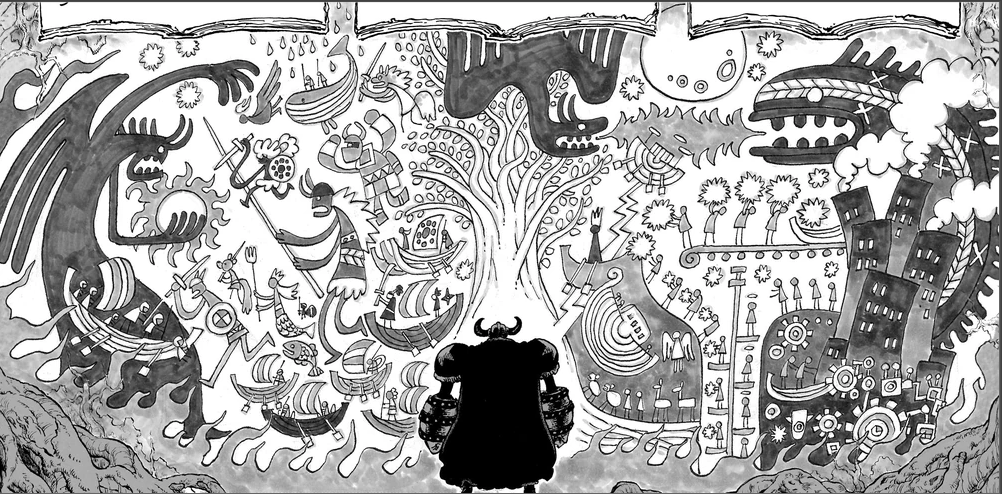
A quick jump to the current One Piece timeline. Something really stood out to me in the Elbaf mural. Oda drew the ships—more precisely, the hulls of the ships—in a very dominant “D” shape. Of course, one could argue that this is just normal ship design, or simply Oda’s style. But with a symbolic interpretation, like the one I’ve been describing, it fits perfectly into the base story of One Piece. The letter “D” in a character’s name is not randomly placed right in the middle. In my opinion, the “D” symbolically stands for the hull of a ship. We’re in a pirate story—this would fit extremely well. The person—the name—would then symbolically represent the helmsman or captain, or the sail and rudder. The bearers of the D. would therefore be people who set and maintain a course on the “high seas”—very fitting for a world that consists mostly of water.

Just like on a ship’s deck, people gather around the D-bearer, who inspires the masses, and together they then steer toward a new future under his leadership. As we already know, a D-bearer possesses an exceptionally strong will, which he uses to change the world. People are inspired, and they literally and symbolically sail along with the D-bearer. What starts as a small, individual breeze (a single D-bearer and his name) ends in a great storm (the gathering of many): “The D. will bring forth a storm.” This fits perfectly with the ability that Mihawk pointed out at Marineford. Luffy can gather people around him and unite them to achieve his goal. Mihawk didn’t call this ability dangerous for nothing. In my view, this fits exactly into Oda’s concept. If Oda has truly stuck to this core principle of the “D” as I’ve described it, then, in my opinion, it still fits every character who carries a “D.” in their name.

What the word “D” stands for

Under the symbolic assumption that the “D” represents the hull of a ship, and that the bearer’s name embodies the will of that “ship,” the question naturally arises: what exactly is being passed on here? If you follow this line of thought to its end, I arrive at the following conclusion.

The “D” stands for:

Diatheke

In Ancient Greek, diatheke refers to a last will or testament. Without having to over-interpret too much, this can be transferred to One Piece very well. It would then be understood as a passed-down or continuing will. In my view, this word fits the concept of One Piece extremely well. We have “inherited will” as a central element of the story. It is not passed on through bloodlines and can transcend generations. All of this fits perfectly with the term diatheke. On top of that, it harmonizes with the letter “D” without pushing the interpretation too far. It’s also striking that Oda very consciously chose the Latin letter “D.” He does not use a Japanese character for it. This makes it not unlikely that the “D” also has a “Western” meaning. Of course, it can’t be something too obvious. And Oda has already drawn from Greek language and mythology with the Ancient Weapons.


The Ancient Kingdom, the Clan of D, and Ohara

In other theories of mine, I strongly assume that the ancient civilization / the Ancient Kingdom, as well as the Clan of D, originally came from the moon. This isn’t strictly necessary for this theory, but it could offer supporting hints. Still, I’d dare to say that if the Ancient Kingdom were called “Diatheke,” it would sound fitting. To me personally—without fan goggles—it feels like “Diatheke” (regardless of its literal meaning) has something mystical and ancient about it. Suitable for an ancient kingdom.

Professor Clover wanted to say the name of the Ancient Kingdom in Robin’s flashback, but was shot before he could. Since then, we’ve been wondering what he wanted to say—and why Robin has never told us. The obvious question is: why did Oda do that? There could be many reasons, but in my view the most likely ones are either that we already know the name of the Ancient Kingdom, but Oda can’t show it to us because we would then be able to deduce something specific—or that we would immediately be able to connect the dots and understand what the “D” stands for. The latter seems more likely to me. In that case, the name of the Ancient Kingdom could be Diatheke.

If my original assumption is correct—that not only the Shandians, Birkan, and Skypieans, but also the Clan of D originally came from the moon and built an ancient, highly advanced city on the Blue Planet—then the name Diatheke would fit even better. It would represent a legacy, a memory, an inherited will of the lunar civilization: “We came from the moon, and we live on here.” One could then argue that the Birkan, Skypieans, and Shandorians should also carry the “D.” That might be possible, but in my view it’s not relevant for this particular theory.

No matter how you read it—even if the ancient civilization or city did not come from the moon—Diatheke would, in my opinion, still convey the same core meaning, just in a different context: an ancient city whose legacy still manifests in One Piece today, and which is therefore dangerous to the world government.

That would also fit Imu’s statement, paraphrased: “The bearers of the D. know nothing of their true strength.” They have literally forgotten it. But the inherited will lives on—Diatheke. I also think it’s no coincidence that the phrase “bearers of the D.” is used so often. Precisely because they carry the will—they fulfill the principle of the diatheke. Other statements can be read in the same way: “The bearers of the D. will bring forth a storm,” or “The D. brings a new dawn.” These are all results of a legacy, of a transmitted will. From this, I conclude that the “D.” stands for Diatheke.

Thanks for your Attention

Daniel M. Doc
 

Vuikua

Registered User
初心者/ Shoshinsha / Beginner
Joined
Dec 2, 2025
Messages
22
Reaction score
10
Age
35
Country
Austria
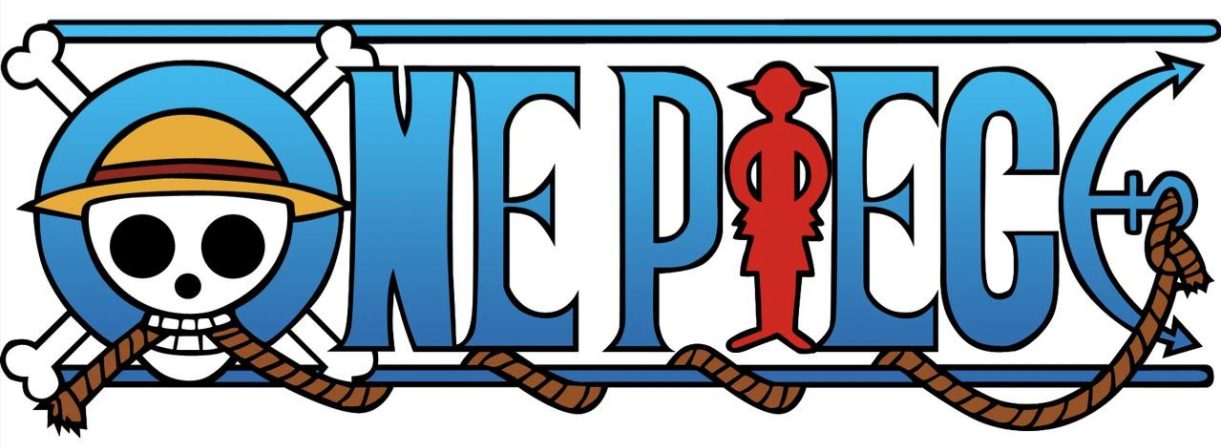
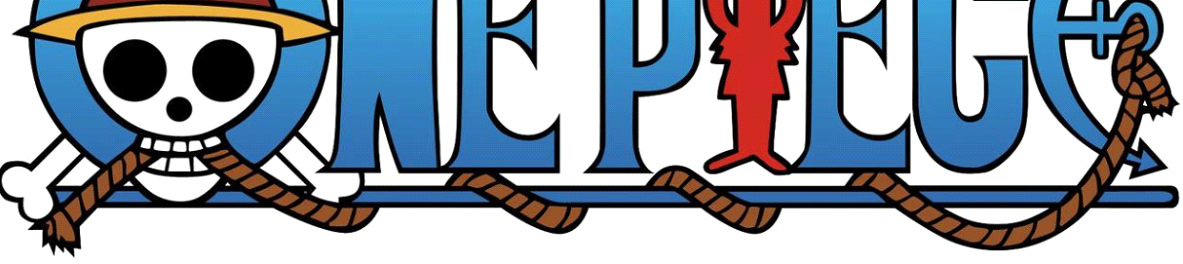
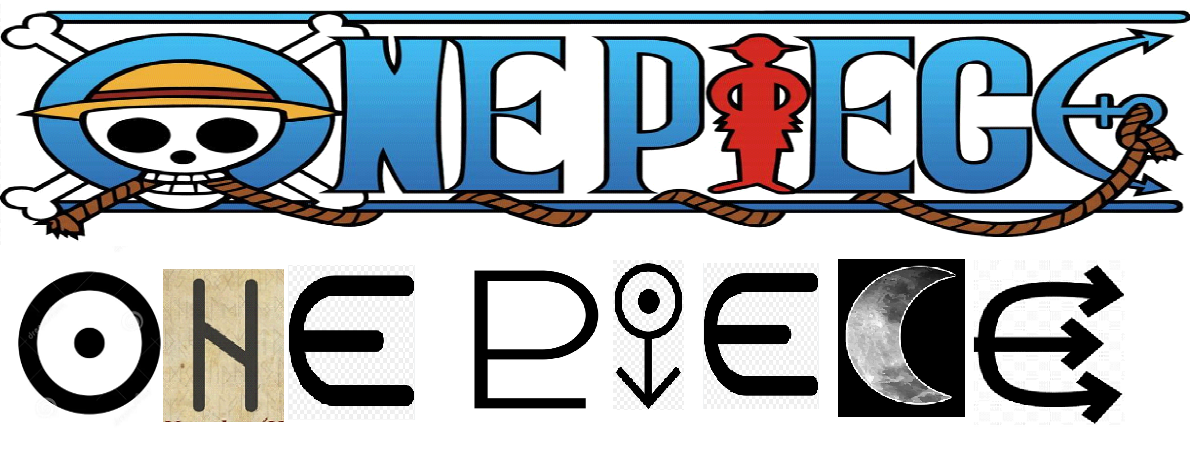
My theory is a theory that directly concerns the One Piece logo itself. To my knowledge, the logo has barely changed up until today and has at least always stayed the same in its overall “shape”.

Here’s a quick look at it:


For me personally, the logo has always felt “special” over the decades. The shape of the letters, the typography, basically the entire visual appearance. So I started thinking: could someone who claims that he had the core story and the ending of his manga planned out from the very beginning not have adjusted the logo accordingly as well? After all, we are talking about Oda. The master of foreshadowing.

And this might sound a bit strange at first, but I think you can actually read the entire story of the current and past One Piece era through symbols embedded in the logo. Oda loves symbols and mythologies, and One Piece constantly shows us that.

Another important thing to mention is that Oda apparently made a very conscious decision back then to use a “Latin, international” word instead of typical Japanese or kanji-based lettering for the logo.

The most important point is this: I am NOT saying that every single detail can be seen in it. But I strongly believe that the red thread of the story can be read from it. When talking about “reading” the logo, we also shouldn’t forget that it was created under the premise that One Piece would only run for about five years, not 26+ years. Because of that, many details and later story additions obviously won’t be included. Still, the red thread I personally recognized is something I would like to share with you.

Now I’ll start with the letter analysis and what I think it represents.

I also want to mention that I oriented myself using existing symbols found online and tried not to pick anything “random”, but rather symbols that actually exist and have cultural backgrounds or appear in real myths and traditions. And a small disclaimer beforehand: as is always the case with symbols, some of them can have multiple meanings. With that said, here is my reading:


The “O” of One Piece

In the logo, we see a circle that represents the “O” itself. Inside of it is a skull wearing a straw hat. The circle itself is crossed by an X, which resembles the bones of a typical pirate flag.


The skull, or rather the reference to the Jolly Roger, obviously stands for piracy. The core message Oda has delivered multiple times regarding piracy in One Piece is “freedom”. Without going too deep into it: Roger was the Pirate King and the freest man in the world, Joy Boy was referred to as the first “pirate”, and Luffy also wants to become the freest man in the world, the Pirate King.

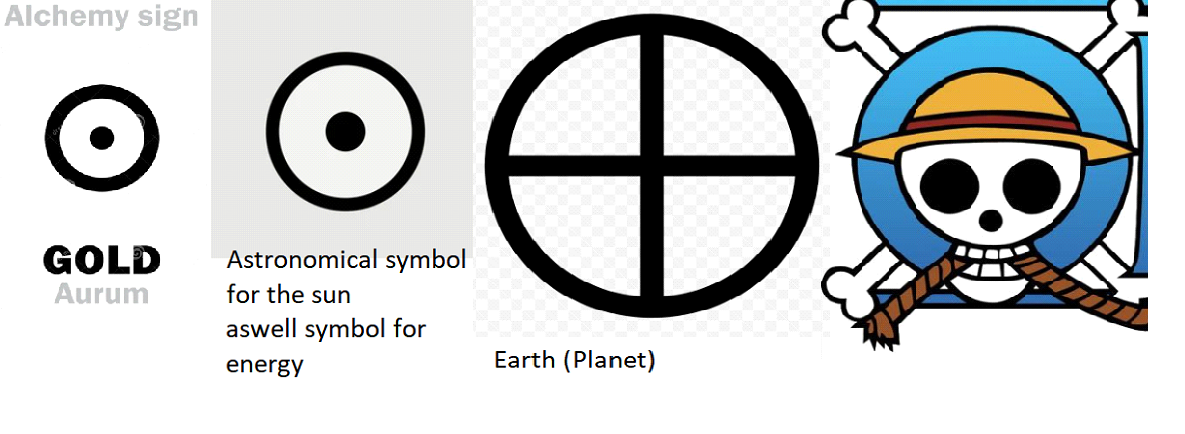
A skull with crossed bones is typical for pirate stories, and we have exactly that included in the “O”. At the same time, the “O” with the “X” can also represent a marking, for example the place where a treasure is buried. Again, very fitting for a pirate story. In astronomy, this symbol also represents Earth, the planet.

Another interesting point for One Piece is that an “O” with a dot in the middle – in this case the skull – is the alchemical symbol for gold. At the same time, it represents the sun in astronomy and, in a broader sense, energy or a source of energy.

According to my research, the straw hat on the skull could symbolize succession or passing something on in Japanese culture. Old objects are often used to represent a transition of roles. It’s not about inherited will in that sense, but more like “it’s your turn now”. We saw exactly that moment when Shanks gave Luffy the straw hat.

The “O” itself is, of course, a circle. Circles are almost always symbols for recurring patterns or cycles. This might sound very on-the-nose, but I still think it’s important to mention.

If we put all of this together and also take the Elbaf mural text into account, I think you can interpret the letter “O” like this:

Piracy in One Piece equals freedom. There is a treasure made of gold (a physical treasure has already been confirmed by Oda) and very likely also energy – possibly an infinite energy source. On top of that, the sun plays a crucial role, which ties directly into the Sun God Nika.

The “planet Earth” meaning is, in my opinion, the weakest part here. Still, it could indicate that the “treasure / gold / energy” lies within or beneath the earth, since the X crosses at the center. Or it could simply represent the world itself as the stage where the story takes place.


Here we continue with the letter “N”.

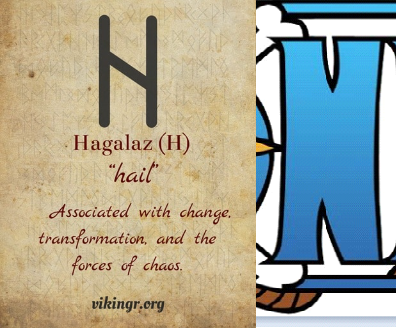
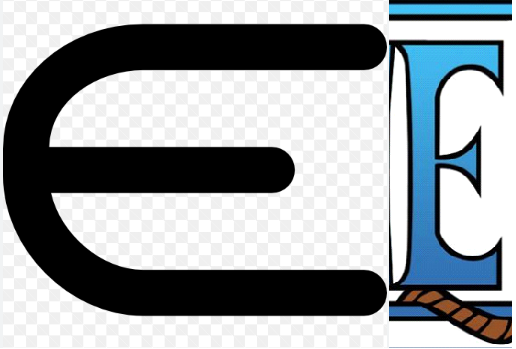
The “N” was the one that broke my brain the most. Still, after a long period of research, I found something that, in my opinion, represents both the letter itself and the meaning behind the symbol and fits One Piece extremely well. I think the letter “N” represents the rune Hagalaz.


Visually, it fits the Latin letter N quite well, but at first it also feels a bit “wrong”. Yes, that’s exactly what I thought too. Until you actually take a closer look at the rune itself. To explain it very briefly: the rune Hagalaz stands for a sudden, unavoidable upheaval. A force of nature that cannot be controlled. It destroys structures not out of malice, but because they are no longer sustainable. Hagalaz represents collapse itself, the kind of collapse that makes a new beginning possible. Hagalaz cannot be prevented, neither through power nor through knowledge.

In my opinion, this symbol fits extremely well with the texts of the Elbaf mural, and especially with the idea of the great overturn during the Void Century. To put it very simply: Imu rose to power, Joy Boy lost, and the Ancient Weapons were used excessively. This collapse of the old “world” is represented perfectly by Hagalaz. Because Hagalaz stands for the event that triggered the collapse in the first place.


Now to the letter “E”

After the “N”, this was the letter that gave me the second biggest headache. Not because I couldn’t find a visual “solution”, but because the context behind it was a big question mark for a long time. However, after identifying the rune Hagalaz, everything suddenly made sense at the END. That’s why I want to explicitly mention here that even if this sounds unclear at first, please keep reading until the end to understand it as a whole.

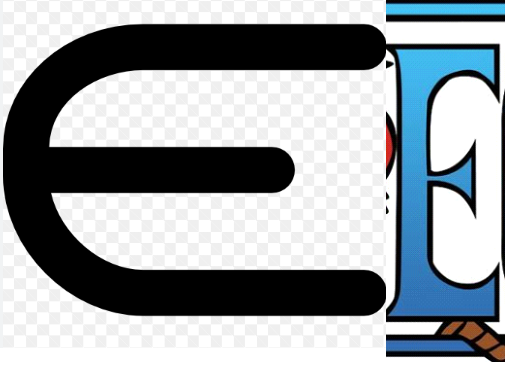
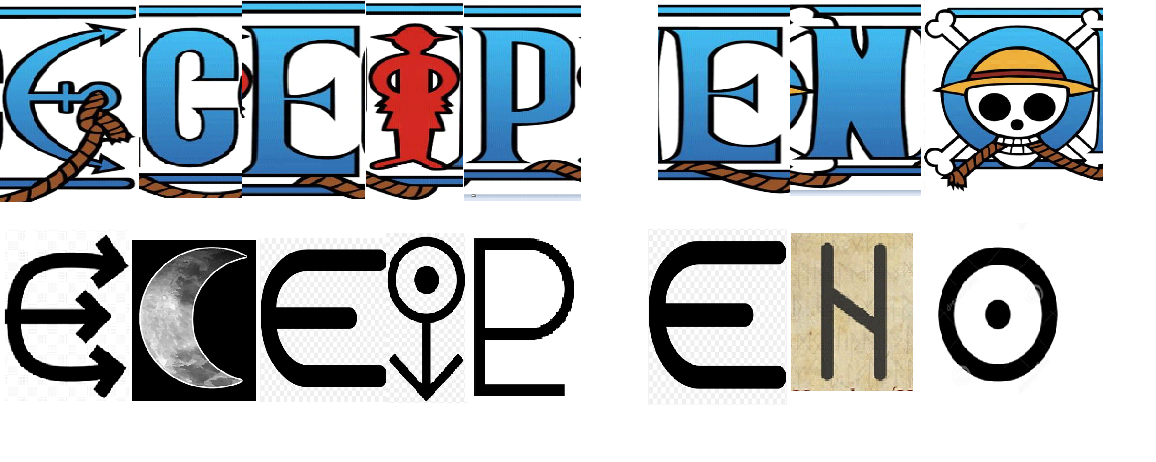
This “E” and the identical “E” that appears later in On ---e--- Pi ---e--- ce are crucial connecting elements. I believe that these two “E”s represent the mathematical symbol “E – element of”.


This symbol means “to be part of” something, for example one part being an element of the next part. It functions as a link, a connection. The letters before and after the word are therefore not meant to be viewed in isolation. Because of that, it is very likely that there are exactly two “E”s that look exactly the same. I understand that this might cause some confusion at this point. Still, I ask you to keep reading. By the end, everything will come together.


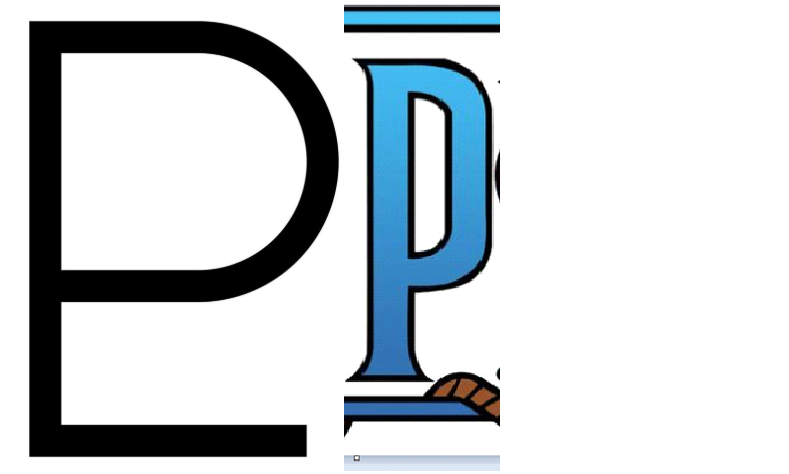
The letter “P”

This Latin letter is the first one that represents one of the Ancient Weapons, namely Pluton.


Pluton most likely stands for the (former) planet Pluto. The astronomical sign we see here is a simplified form of Pluto’s astronomical symbol. Unfortunately, we don’t know that much about Pluton in One Piece. The most reliable things we do know are that it is some kind of warship and that it can be reproduced through blueprints.

Symbolically, Pluto stands for the god of the underworld – meaning the underground, and also for changes that are irreversible. Because of that, it fits extremely well that Pluton was “buried / hidden / put to sleep” in Wano Kuni. It is literally underground. We also know that Pluton can make entire islands “disappear”. Pluton most likely causes tectonic changes. This is also where you can draw a connection back to the rune Hagalaz (N). Hagalaz would be the irreversible collapse, and Pluton would then be a tool of that collapse. In that sense, it also fits perfectly that its actions are irreversible. Again, very fitting for a world order that is being overthrown or fundamentally rearranged. And once more, this also lines up with the 200m sea level rise during the Lost Century.

Very typical for Oda would be the idea that weapons themselves are not inherently evil, but rather the person who uses them “wrongly”.


Now we get to the letter with the biggest range of possibilities – and for me, the hardest one to pin down – the “I”

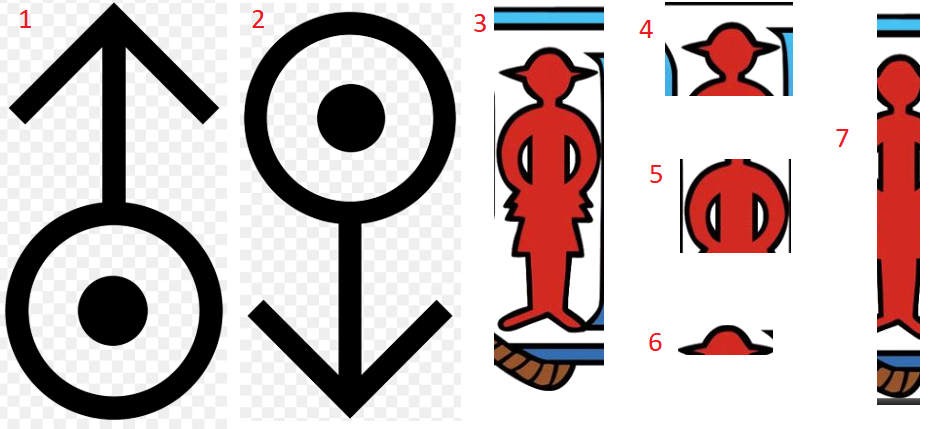
This letter truly stands out. It’s not “just” a symbol, it also has a very human-like shape. It feels almost like a figure resembling Luffy. The “I” is marked in red on purpose and looks like a line that has been stretched vertically. It also looks like it’s wearing a straw hat, or at least something very similar.


Ad. 1: This is the astronomical symbol for Uranus. If you rotate the symbol by 180 degrees, it is literally turned upside down, as shown in ad. 2. Just a small parallel here to Roger’s line about “turning the world upside down”. When rotated, it fits very well into the shape shown in ad. 3 (aside from the feet pointing in a different direction).


Ad. 4: This can point in multiple directions. On one hand, I think it naturally represents a person and their head. On the other hand, it could represent the planet itself. And yes, Uranus – the real planet – does have rings, and that has been known for almost 50 years now. It also looks like this person is wearing a straw hat. And WITHOUT OPENING THE ENEL CAN OF WORMS, I just want to point out that this “circle” in Enel’s cover story has very strong similarities to the “head part” shown in ad. 4. Especially the ramp leading outward really looks like it could be the “straw hat”.

Ad. 5: This looks very similar to the symbol of the sun and the symbol for gold and energy, which I already talked about in more detail with the “O”.

Ad. 6: What’s interesting is that if you split the “head part” from ad. 4 in half, it almost looks like a “D”. I’ve personally mentioned many times that I suspect the “D” also came from the moon. When you connect that with ad. 5, it suddenly doesn’t feel that far-fetched anymore. Still, this is a rather weak argument, since every “halved” circle technically becomes a “D”.

Ad. 7: What really stands out is the red color. To me, it looks less like a filled surface and more like a line stretched vertically. What if the Red Line is also hidden here? At the very least, as a red thread – which is the core idea behind my entire theory – I think it’s plausible.

Putting everything together, Uranus stands for the sky, or order from above, in mythology. That implies a higher authority and absolute power. I personally think Uranus has not yet been revealed in One Piece, and I also don’t think it’s impossible that the weapon that destroyed Lulusia was something else. That’s just my personal opinion.

If ad. 7 really represents the Red Line, then Uranus would be hidden in ad. 5. Ad. 5 would then function similarly to the “O” in the logo. A circle with a dot inside – that’s where energy or the sun is, and by extension, also the sky. Because a circle with a dot in the center can also be read as the “center of the heavens”.

Uranus will most likely be the force that establishes order “from above” in One Piece.


Again, the letter “E”

Now, as announced before, the same “E” appears once more.


It will serve the exact same function as the previous “E” – meaning “element of”. What exactly is being connected by this, and how I arrived at that conclusion, I’ll explain at the end.


The “C” and its meaning

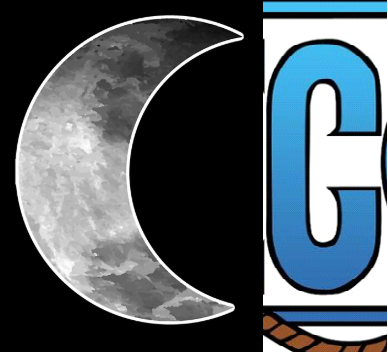
The “C” is already very deeply rooted in One Piece. I mentioned it briefly earlier. I think this letter represents the symbol of the moon.


We already know about a moon culture through Enel’s cover story. Shandorians, Skypieans, and Birkans most likely came from the moon down to Earth. Very often, the Ancient Civilization is linked to the moon people. Basically, the idea that the highly advanced Ancient Kingdom either came from the moon, or at least that its knowledge originated there. This isn’t meant to dive deep into that theory itself, but once again to focus on the “red thread” I mentioned at the beginning. This most likely revolves around knowledge that was brought down. Symbolically, the moon also stands for memories and for knowledge that has been forgotten. On top of that, the moon always represents cycles – disappearance and return.


The last “E”, which looks different

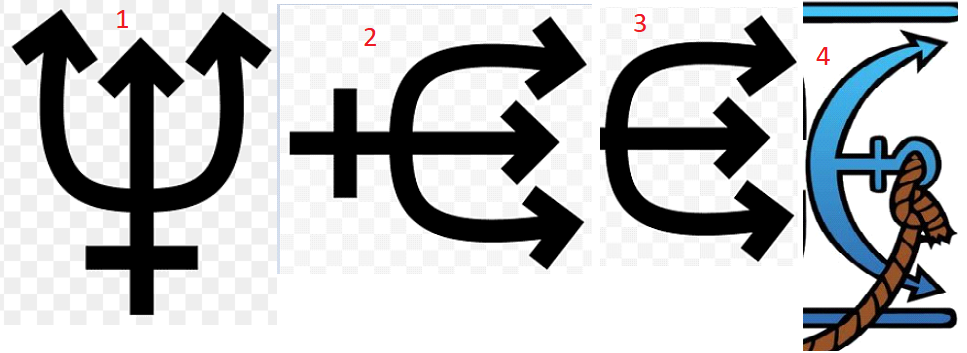
With this letter, things become a bit more ambiguous again. This one represents the last of the three Ancient Weapons: Poseidon.


Poseidon and “Neptune” are almost the same in name and meaning. The symbols associated with them are also structured very similarly, most commonly featuring a trident. In ad. 1, I rotated the symbol by 90 degrees, as shown in ad. 2. After that, I removed the shaft in ad. 3. That’s how I arrived at ad. 4.

Yes, in ad. 4 we end up with a clearly defined anchor, which can be seen as derived from the Poseidon symbol. Why the anchor itself is still important is something I’ll get into next. What an anchor and Poseidon/Neptune definitely share, though, is the idea of regulation. They maintain balance on a symbolic level. Especially Poseidon/Neptune when it comes to the sea.

Now I’ve explained every symbol individually according to my theory, but there are still some points missing that I want to address next.


The rope:

The rope is deliberately “anchored” in Poseidon in the last “E”. At the same time, it is being held by the skull, which represents piracy and, by extension, freedom. The rope indirectly runs through all the letters and wraps around the “blue line” at the bottom. To me, it looks like it’s being pulled from right to left. This will become very important for the assumptions that follow.


A rope symbolically stands for support. Not for stagnation, but for holding on to something so it doesn’t get lost. Because of that, I don’t think it’s a coincidence that it’s the skull – representing freedom – that is holding the rope.

Joy Boy himself made a promise to the Mermaid Princess and left her an apology message through the Poneglyph.


The “two lines”:

Many theories about the two lines usually refer to boundary lines or the Calm Belt. For a long time, I thought the same thing myself. Like, yeah, why not. But then, especially when connecting it with the rope and also taking the Elbaf mural into account, a different reading direction came to mind.


I think the two lines represent two reading directions. This part is important, so please read it all the way through, because it will make sense at the end.

As I already mentioned with the rope, it feels like it is tied or pulled from right to left, with the skull holding it in its mouth. That would imply that this reading direction, from right to left, represents the past.

In the opposite sense, the upper line would then represent the future, with the reading direction going from left to right.

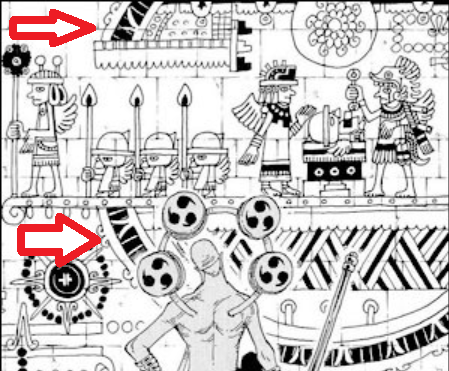
The reason I’m even suggesting reading directions in the first place is because of the Elbaf mural.


If you look at its reading direction the way it is traditionally done in Japan, you would read it from right to left. Without opening that whole topic and without going into too much detail: on the right side, it depicts an ancient city, and on the left side, it shows a war that most likely resulted from it. That forms a clear temporal sequence. Because of that, and because of the symbolism involving the rope and the skull, I personally conclude that a right-to-left reading direction represents the past, while a left-to-right reading direction represents the future or the present.


From that, the following symbol sequences emerge:

Reading direction from left to right: present into the future, the story we are experiencing.


A short and concise explanation, without drifting too far away from the red thread:

“O” stands for origin, sun, gold, energy. Most likely the infinite energy source. The circle with the X marks the treasure, the location. Free pirates who change the world, because

“N” is Hagalaz, the collapse. Something shakes the world in its existing patterns.

“E” here functions exactly as a connecting element for what follows (“element of”). This results in a classification into the new system after Hagalaz (N).

“P” represents tectonic plates, shifts of the earth, “underworld movement” through Pluton.

“I” stands for order from above based on the new upheaval (sky), with the possibility that the Red Line is involved (marked in red), maybe also connected to the “D” through that theory. This would also fit the statement that “the D will cause a storm”, in relation to the sky.

“E” means these events are part of a greater whole, everything is being ordered.

“C” represents lost knowledge – moon people / Ohara – returning.

“E” stands for the stabilization of balance.

Or:

Reading direction from right to left: the story of the past.


A short and concise explanation, without drifting away from the red thread:

“E” the world is in balance, it is harmonious.

“C” the moon people arrive on the blue planet, knowledge is passed on.

“E” everything is part of a whole.

“I” a higher power or order emerges.

“P” physical interventions take place, for example the sea level rises.

“E” everything is embedded into a new system or world order.

“N” an irreversible collapse of the old structure takes place.

“O” the treasure, the energy, the “sun”, the origin is lost or hidden.

For both reading directions, it’s important to note that the “E” from mathematics is not meant in a literal mathematical sense, but rather as a sense of belonging or being part of something.

The final and decisive question I asked myself was this: could Oda really have done something like this almost 27 years ago? After all, the internet didn’t exist back then. But the way One Piece has consistently shown us over time, Oda has always been deeply interested in symbols and myths. That doesn’t mean he explicitly did it this way, but there is a real possibility that he set a red thread for himself and embedded it directly into the logo.

What really stands out is that the word One Piece is not written in kanji. On top of that, based on my research, there isn’t a single symbol involved that wouldn’t have been “normal” to research with the means available at the time. A lot of this was even taught in schools. The most “unlikely” element would be the Hagalaz rune for the “N”. However, Oda himself has said that he is a fan of Vicky the Viking, which directly ties into Elbaf, Norse mythology, and Viking culture. Because of that, it’s actually quite plausible that Oda had already thought about these things back then and gathered information on them.


if you are interested in more theories, plz check out the following google doc:

My Theory Archive

There are a lot of different theories which kinda fits together.
Thanks
Daniel M. Doc
 
Last edited:

Vuikua

Registered User
初心者/ Shoshinsha / Beginner
Joined
Dec 2, 2025
Messages
22
Reaction score
10
Age
35
Country
Austria
In One Piece, it’s often misunderstandings, not enemies.

I want to present a controversial theory that could still work within One Piece and its own rules and logic.

I’ll take a closer look at the following points:

--- Where Devil Fruits truly come from

--- What role the sea plays

--- Why water weakens them

--- What happens after death

--- When rules stop applying

--- Why Blackbeard is different

Vegapunk and the Devil Fruits

One of the strongest statements we have about Devil Fruits comes from Vegapunk.

To simplify it: “Devil Fruits are the result of human desires.”

I think Oda very deliberately left it at that, to make us keep thinking. He did say once in an SBS that at some point in the story a professor would appear and explain everything about Devil Fruits. Most people assumed that this would be Vegapunk — and I do too.

Still, his statement feels a bit too vague and not fully complete, at least to me. It doesn’t feel like the whole answer yet. I do believe that Vegapunk — or one of his clones — will eventually give us the full explanation, but only later in the story.

For now, I want to present my answer:

How did Devil Fruits come into existence?

During the Skypiea arc, Kalgara tells Noland that the dead continue to live on in their “trees” — their souls move there. That doesn’t mean every soul has its own tree, but rather that souls can wander. That’s why the trees were considered sacred.

In my opinion, this was foreshadowing for the origin of Devil Fruits.

Because in Dressrosa, the “SMILE” fruits were also grown on trees. Along with that came other cultivation mechanisms like water, light, soil, “trees” themselves, and additionally things like ingredients of animal origin and S.A.D.

I think there really could be a core truth behind Kalgara’s statement. He also didn’t assign a soul to one specific tree. So wouldn’t it be possible that the souls of people who had a very strong will in One Piece could migrate into a tree? That doesn’t mean that only one soul exists in a tree — the tree could function as a storage medium for many souls.

Another possible piece of foreshadowing regarding souls is Brook himself. We know for a fact that souls exist in One Piece. After Brook’s death, his soul wandered around trying to find his body again. Following this soul-logic, I don’t think every soul would be compatible with every other soul inside a tree. In short, they would literally fight over space like “little children.”

Because of that, I assume that only souls that shared the same desire in life are compatible with each other. As a result, many souls could gather within one tree and continue to live on there, just like Kalgara described.

If I take this thought further and apply it to the core theme of One Piece — inherited will — it would mean the following:

A large number of souls inside a tree. These souls have a very strongly defined will and have settled there over centuries or even longer. They all share the same will. A will like:

“I want to be fire.”

Or “I want to be mochi.”

Or “I want to be as strong and wild as a leopard.”

This shared will of many souls could cause a Devil Fruit to sprout on that tree — one that embodies exactly the will those people dreamed of. This fits especially well with Zoan fruits, in my opinion. Wanting to be an animal and truly loving and embodying that animal also means reflecting everything about it — including the wildness. That’s why, to me, the “wildness” of Zoan fruits fits this idea perfectly.

The fruit form itself also fits the tree theme perfectly, in my view. The shape of a fruit isn’t random. A fruit stands for temptation, for growth, and for a conscious decision. I think you can even bring up Eve from the Bible here — even though she was tempted by the snake, she still perceived the fruit as tempting and chose to eat it. In the end, you take something into yourself, sacrifice your own body, and let something foreign grow inside you. In return, you gain abilities, which can ultimately be a positive trade-off.

There are countless different fruits in One Piece — different shapes, bananas, apricots, apples, and also many sub-forms of those fruits. This gives Oda a huge pool of designs to draw from without it feeling “inflationary.” We already know of 200+ Devil Fruits, and to me, this just fits.

Is the sea an enemy of Devil Fruits?

It has been implied multiple times that the sea is hostile toward Devil Fruits. We’re told that Devil Fruits represent something “unnatural,” and that the sea corrects this “disorder.”

But is that really the case? Or is this just the logical conclusion the characters themselves draw, simply because they literally lose the ability to act underwater? In short: a sailor’s tale?

Oda loves playing with our expectations. He often leaves us in the dark, only to later present his resolution. He twists things in subtle ways that we realistically couldn’t figure out — unless we turn the facts back around and start to dream ourselves. I don’t think the sea is the enemy of Devil Fruits. The sea is repeatedly described as the “cradle of life.” It is literally in harmony with the origin of life itself. Ergo, the sea is the mother of all life. And a true mother does not reject her children — even if, in One Piece, this sometimes seems to happen. But in my view, those are exceptions, not “true mothers.”

Devil Fruits are nothing more than souls that were once bound to human bodies, that later found themselves within a tree. From their shared will, they created a Devil Fruit. To me, that is creation. In a very exaggerated sense, it’s even comparable to scientific achievements — something a mother would have every reason to be proud of.

“Powerlessness” of Devil Fruit users underwater

So why do Devil Fruit users still sink in the sea? Here we really have to stay specific and stick closely to Oda’s facts.
Simply put: in still water, the user sinks and becomes “weak.” In flowing water, it barely affects them at all — for example, a Devil Fruit user can shower and fight in the rain, but can lose part of their strength even in a puddle. What matters less is the type of water and more its amount and its state.

If the sea — the cradle of life — represents the mother, then the logical consequence is that still water represents a cradle. To explain this with an example involving babies: most babies fall asleep when they are being “rocked.” That means being bounced, swayed, or literally placed in a cradle — the “babies” come to rest. And that’s the crucial point.

In the sea — the cradle of life / the mother — Devil Fruits come to rest. It’s important to say that this specifically applies to still, surrounding water. Once again, very typical Oda: two sides of the same coin.

At this point, a parallel to sirens fits very well. Sirens do not actively kill their victims. They don’t attack anyone and they don’t act out of hostility. Instead, they take away a person’s ability to act. Those who fall for their song no longer fight, no longer swim — they let go. Death is not the sirens’ goal, but a consequence of passivity.

If you apply this idea to the sea in One Piece, a very similar picture emerges. The sea does not take away a Devil Fruit user’s power. The ability doesn’t just disappear. Rather, the user loses the ability to actively act. The Devil Fruit comes to rest, the body becomes heavy, and the person sinks. Not because the sea is hostile, but because everything becomes still. The “rocking” just inverted — meaning still water.

There’s one more thought I want to bring up here, based on something Oda once said when asked about “who is Luffy’s mother.” Oda said, roughly, that a journey of adventure only begins once you leave the mother’s womb. That would mean that when you return to your mother, the adventure is over. Applied to Devil Fruits, this would mean that when they return to the sea, their journey ends and they come “to” rest.

Seastone would follow the same principle. As far as we know, Seastone is made of a material that reflects the same properties as the sea itself. Depending on its composition, the Seastone effect is stronger or weaker. That again fits perfectly with the “cradle of life” theme. Seastone brings the Devil Fruit to rest, and through that, the user becomes weaker.

The bond between a Devil Fruit and its user

To this day, we still don’t really know where and how a Devil Fruit binds itself to a user’s body. If, as in my theory, a Devil Fruit is actually a collective of souls with a strongly defined will, then it would only make sense that this will — in other words, emotions — binds itself to the user’s own emotions.

In the end, a Devil Fruit chooses its user. And it would only do that if the user were meant for it. From that perspective, the idea fits that the Devil Fruit literally attaches itself to the user’s feelings. We already had a small piece of interpretative foreshadowing through God Usopp, aka Sogeking. Usopp explained to us that Sniper Island lies in the heart. This can be applied perfectly in a metaphorical way to Devil Fruits. The Devil Fruit does not physically reside in the heart, but it is bound to the emotions of the person who ate it. This also explains why and how a Devil Fruit can be “awakened.” And it would also explain the “awakened” forms of the jailer beasts in Impel Down, where the Devil Fruit has taken control over the user. In those cases, the user was not emotionally in harmony with the Devil Fruit — as a result, the “desire to become a beast” overtook the user.

Binding to emotions also explains why Devil Fruit users can only eat one Devil Fruit. If a Devil Fruit is a massive accumulation of emotions (the desire to be something specific), and this is in harmony with the user (the right Devil Fruit), but the user then eats another Devil Fruit, there can only be a “conflict” inside the body. Again, like “children” fighting each other. The emotional chaos is something neither the user nor the body can withstand — the user dies or literally explodes. That’s how, within my theory, I would explain the assumption that you cannot eat two Devil Fruits.

You could also draw a parallel here to the SMILE fruits. Their “flaws” literally force users to laugh forever — they lose the ability to express emotions. I think this is a huge piece of potential foreshadowing.

Respawning of Devil Fruits

People — and animals — never stop dreaming. All over the world, even if not directly tied to a tree, there will be invisible accumulations of wishes and hopes. I think that wherever the desire — to be that exact Devil Fruit — is strongest, that’s where the Devil Fruit will respawn after the user’s death. Because of that, the statement that a Devil Fruit can respawn anywhere in the world is still correct. In this context, Vegapunk’s view on wishes and dreams fits very well. They are invisible too, but according to him, still real and capable of influencing the world. In the case that a Devil Fruit user dies underwater, I also have a solution that would work within my theory. The desire seems unable to leave the sea at first — at least according to my idea. Since the Devil Fruit comes to rest in the mother’s womb (the sea), the fruit can no longer respawn in the world. The sea therefore acts like a barrier, almost like a shield that blocks everything off.

The Devil Fruit no longer exists there in a manifested form — that’s how I see it. The desire — the journey — ends here.

Important: this does not mean that the Devil Fruit is lost forever, but that it is no longer part of the world’s cycle. What I mean by that, I’ll explain in more detail later.

Why does Blackbeard represent an exception then?

Blackbeard’s Devil Fruit — the Yami Yami no Mi — is very strongly aligned with the properties of the sea. His Devil Fruit annuls other Devil Fruit powers — meaning it brings them to rest. Within this logic, his Devil Fruit is most likely the result of a collective wish to possess or be a “water / sea fruit,” to be like the water or the sea itself. I don’t think we ever get closer to a water-based Devil Fruit in One Piece than Blackbeard’s. At Marineford, Blackbeard showed that he is capable of “eating” two Devil Fruits. I think I’ve found a practical explanation for this as well, based on my theory, and I want to go into it in detail now.

If the sea is capable of bringing Devil Fruits “to rest,” then the Yami Yami no Mi would do exactly the same thing. That means that at the moment of Whitebeard’s death, Blackbeard intentionally threw a black cloth — darkness — over Whitebeard. He then activated his Devil Fruit ability to bring Whitebeard’s Devil Fruit “to rest,” and through the combination of the black cloth and his darkness powers, he effectively created a sealed-off space. The same kind of space would be created if a Devil Fruit user were to die at the bottom of the sea. The Devil Fruit would also come to rest there and would not be able to respawn elsewhere in the world. When Whitebeard was truly dead, Blackbeard’s desire to possess the Tremor Fruit was at its strongest. Since he had created a space that resembled the sea, the fruit had no other choice but to respawn within his area. That’s when he claimed it.

According to my theory, a Devil Fruit consists of a collective of wishes — which don’t necessarily have to be compatible with the user. A second Devil Fruit would normally cause a collapse of emotions. But since Blackbeard’s second Devil Fruit represents the “sea” and therefore creates “rest,” it becomes possible for him to consume another Devil Fruit.

Purely hypothetically, depending on the strength of the Yami Yami no Mi, it might even be possible to consume more Devil Fruits using this principle. The natural limiter here would be the massive “effort” required to suppress the other Devil Fruits — to keep them at rest — and the risk of consuming additional Devil Fruits simply becoming too high.

The forest of Devil Fruits

According to another theory I developed and already posted before, the All Blue was located in the heart of the Red Line. To put it simply: the massive amounts of water that flooded the world had to come from somewhere. The Red Line is enormous, and in some images — like Imu’s cold chamber with the giant straw hat — you can see huge, catacomb-like structures. To me, they look similar to melted glaciers. That makes it seem as if water was stored there X years ago. After the use of the three Ancient Weapons, that water was released, and the Red Line itself may have been permanently altered.

According to my theory, the All Blue was inside the Red Line. All bodies of water flowed together there, regardless of whether they were fresh or saltwater. Minerals and substances mixed together. At the same time, the Red Line as a massive rock formation could have infused important minerals into the water.

Additionally, the Eve Tree is located at the Sabaody Archipelago, close to the Red Line. Its roots are known to reach all the way down to Fish-Man Island at a depth of 10,000 meters — meaning they almost certainly extend into the Red Line as well. There, the All Blue would once again be supplied with nutrients. It’s also very likely that there were “holes” within the Red Line’s mountain mass. Possibly caused by erosion, or by the Eve Tree itself. In any case, “light domes” could have formed. This would once again reflect the recurring “four gods” motif: water, light (sun), earth, and forest (tree).

Because of this, I think it’s not only possible but actually likely that some kind of “forest” once formed in the middle of the Red Line. There, souls — as described in the Shandora legend — could gather in the trees. And if a large, wish-strong collective existed, there would be the possibility of a Devil Fruit forming on one of those trees. The necessary resources of the entire world would literally be available there in one central place. Something very similar was already shown with the production of SMILE fruits.

This could also explain the “treasure” of Mary Geoise that Doflamingo once mentioned. It would literally be a Devil Fruit factory — currently stopped, but not truly destroyed. It’s just waiting for the final required resource: the All Blue.

Right now, the All Blue doesn’t exist. That would mean the trees — or the forest itself — could still exist, but simply lack the necessary “resources” to produce Devil Fruits.

Respawning of Devil Fruits when the user dies underwater

I assume that when a Devil Fruit user dies underwater, their Devil Fruit cannot return, because the water acts as a kind of blockade. Using the “mother” analogy, that would mean the Devil Fruit has returned and can no longer go on an “adventure.” It rests there forever, and the desire loses its active form.

As a consequence, this is exactly what makes it possible — under the condition that the All Blue is restored — for the Devil Fruit to grow again. Not respawn, but grow anew. The desire fully emerges once more. This gives Oda the option to “end” Devil Fruits — or to have already ended them — without removing them completely from the story. Basically, a safety net. That would mean that if the All Blue were to exist again, Devil Fruits could come into being once more through the necessary wishes of the people. This also feels like a very fitting possible continuation toward the end of One Piece.

So the sea ends the manifestation of Devil Fruits (unintentionally), but the forest allows them to be born again.

The cycle begins anew.

Thanks for your attention

Daniel M. Doc.
 

Vuikua

Registered User
初心者/ Shoshinsha / Beginner
Joined
Dec 2, 2025
Messages
22
Reaction score
10
Age
35
Country
Austria
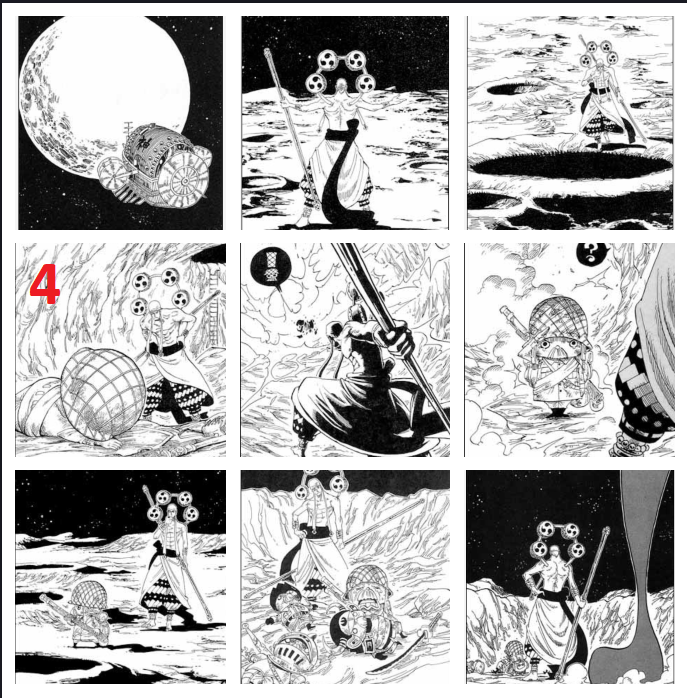
Most people only remember Enel’s cover story for the famous moon murals and the Birka revelation.

But the real hidden clue isn’t on the walls at all.

It’s in the timeline.

The cover story subtly breaks its own chronology — and that break may connect directly to Marie Geoise… And if that timeline shift is intentional… then something may have been waiting far longer than we realized.


The Chronological Break
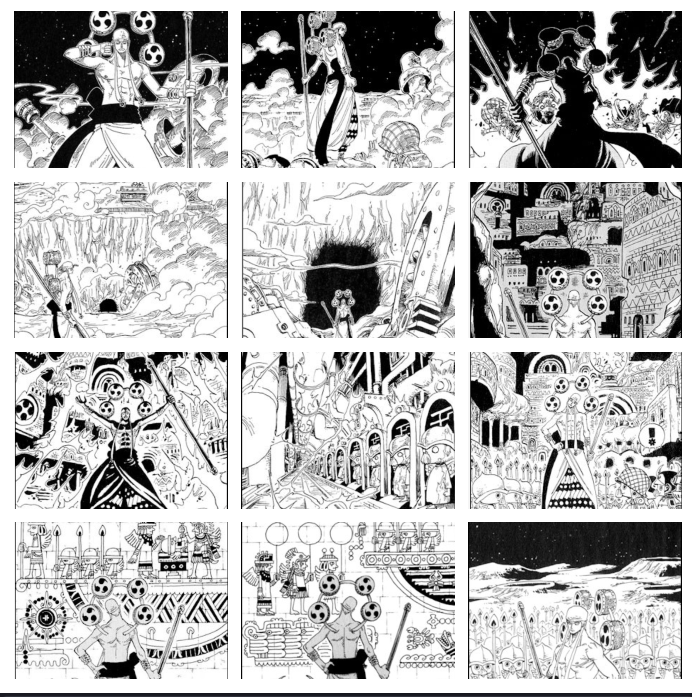
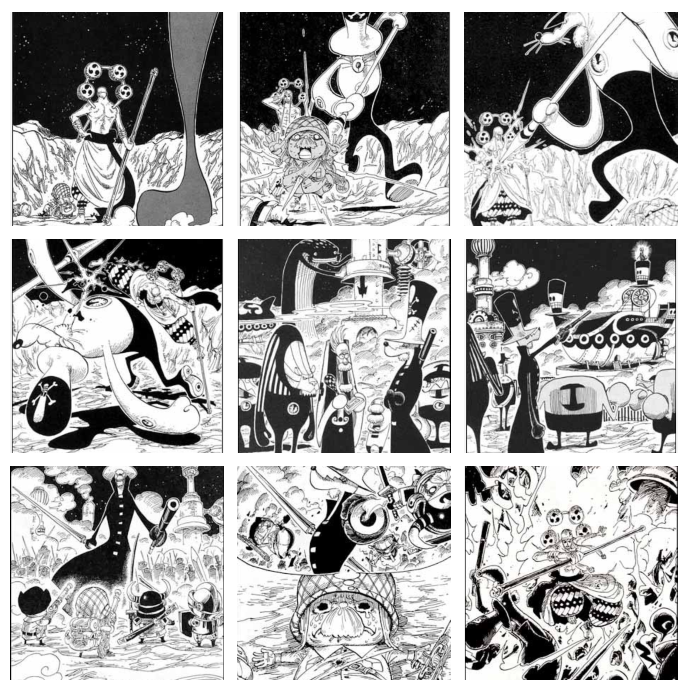
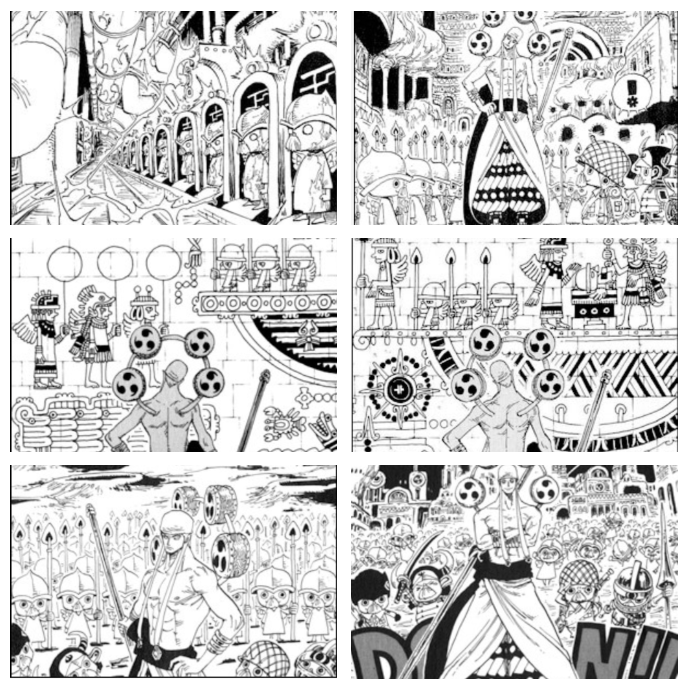
Something caught my attention in Enel’s cover story that has nothing to do with the two famous panels. What stands out is that in the cover story the chronological order is deliberately interrupted, which you don’t immediately notice at first glance.


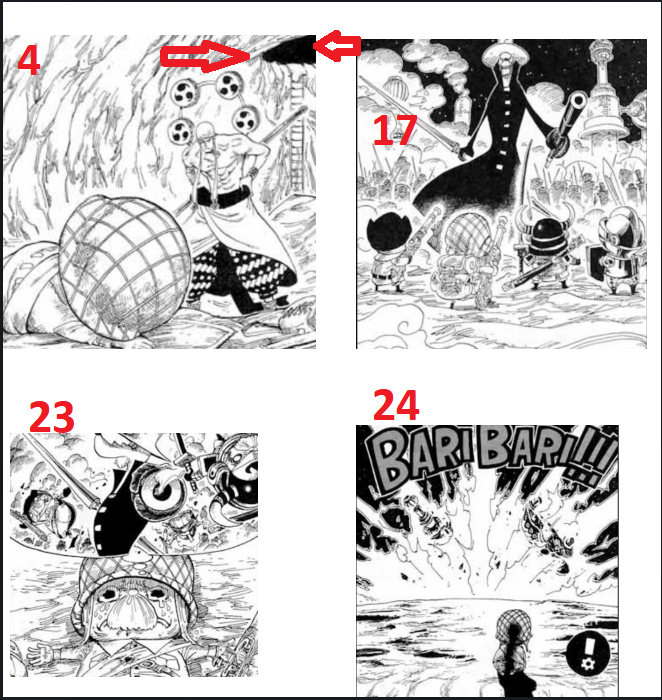
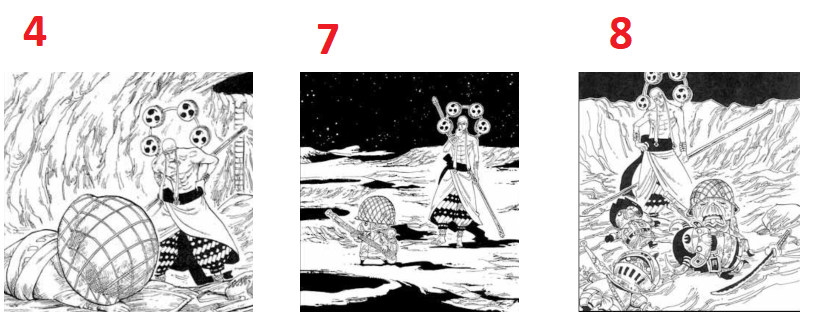
Here everything still seems to follow completely normal. Picture number 4 will become especially important later. In it, the “military” automata is inside a moon crater.


Then it continues chronologically again from panel 9 to number 16.

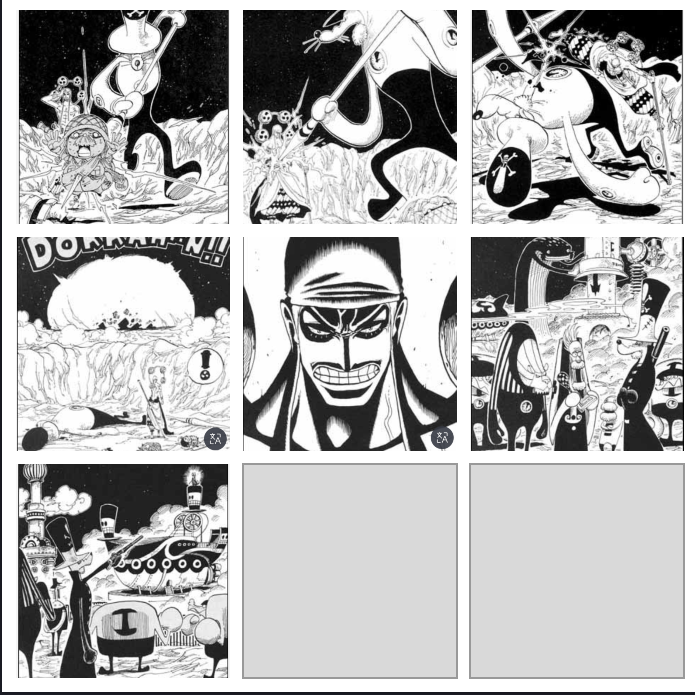
After that, we enter the flashback of the automatas.

Although it is even possible that picture 15 and 16 are already the flashback. Why, I will explain in a moment.


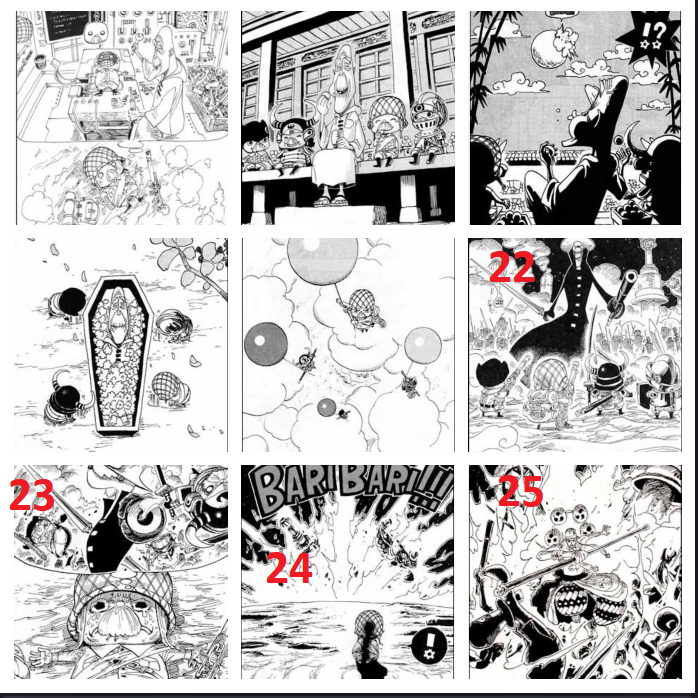
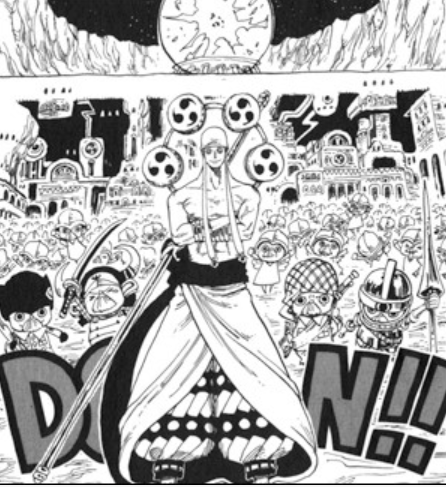
Now pictures 23 – 24 – 25 are highly interesting. Because everything before that, meaning from 17 to 22, we are inside a flashback. Especially picture 22 is very important. Because that is STILL inside the flashback.

This image is extremely misleading. You assume that it represents the present, especially because of the chronological order in the cover story, but it was the arrival of the automatas on the moon – so the past – where they confronted the Space Pirates.

And this is very important: in picture 23 and the ones following, we are back in the present where Enel has already set foot on the moon.


The Crater Detail – The Key Evidence
And in picture number 4 it is clearly visible that the automata is INSIDE A CRATER. You can clearly see it because of the ladder. This image is after Enel’s arrival on the moon. That means they already fought against the Space Pirates in the past in picture 17, were separated, and lost. Because in picture 7 and 8 it is chronologically clearly visible that the military automata left the crater together with Enel and outside of the crater found the remaining automatas.

In picture 23 and 24, we are back in the present with Enel.

That means the automatas came to the moon, fought against the Space Pirates, were separated, lost, and only after that Enel came to the moon and found the military automata. The most important thing is: we have no time indications here.

Professor Moonwatcher and the Moon Origin
Why is that important? Because of Professor Moonwatcher.

Professor Moonwatcher “developed” the automatas on the blue planet — whether he created them or based them on blueprints is not clear. Also in which time period he lived is not clearly defined — it was deliberately left open. His mansion feels more “old” than a newer estate — but that does not have to mean anything.


What is extremely interesting is that the automatas from the blue planet have a very strong similarity to the automatas on the moon. That only allows one conclusion. That the automatas from the moon came to Earth together with the moon civilization. There, in some form, they had a function. Maybe they were also common knowledge. But in any case Professor Moonwatcher came into contact with them and he either “remodeled” them or reproduced them based on blueprints.

That means Professor Moonwatcher lived in a time when the moon people came to the blue planet. This time period is not defined, but the probability exists that it represents the Void Century.

Karakuri Island and the Climate Question
Another hint would be Karakuri Island itself. It was confirmed that the events of Professor Moonwatcher’s flashback in the cover story take place on Karakuri Island. We know that Karakuri Island is the homeland of Vegapunk and that Kuma sent Franky there during the timeskip. We also know that Karakuri Island is titled as a winter island. In One Piece, islands are only called winter islands when winter exists there all the time. Even during the timeskip, permanent winter reigns on Karakuri Island. Vegapunk so far has only transformed Egghead Island from a winter island into a “summer island” using a climate device.

A similar statement was made about Blackbeard — he is supposed to come from a winter island and because of that he never sleeps, because it is so cold there. People would die if they sleep (not true for everyone).


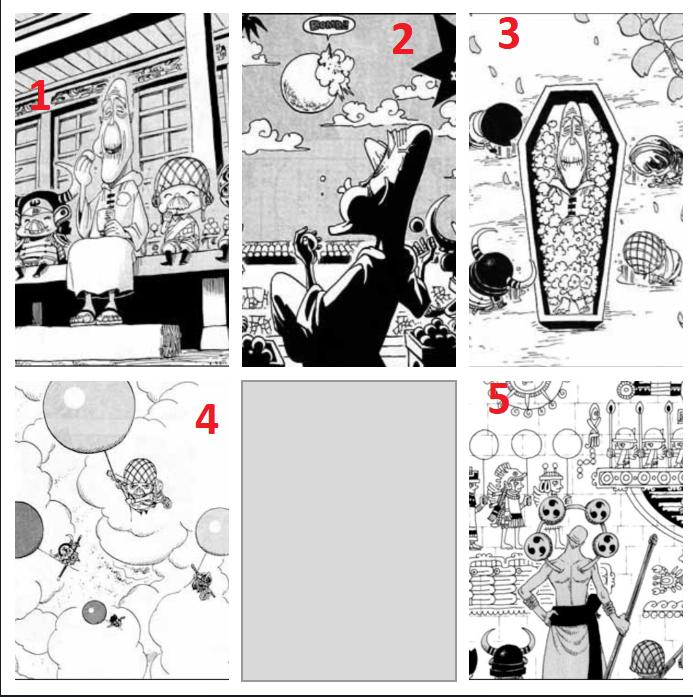
As you can clearly see in picture 1–3: no snow, no ice, no winter landscape. More like “blossoms”.
It feels rather mild – spring-like. Even the clothing style of Professor Moonwatcher speaks more for warmer temperatures.

If the automatas really came from the moon — and I think the evidence speaks for that — then the name of Professor Moonwatcher would also be very fitting. He could have had knowledge about the moon civilization. He appears quite advanced in technology. He was always observing the moon, maybe because he knew that people came from there, or maybe it was even his own homeland?

Furthermore, we know that during the Void Century a war prevailed that permanently changed the world in One Piece. Most theories also assume that climate zones were altered or even created through the use of the Ancient Weapons. Therefore I think it is very likely that Karakuri Island previously had a milder climate or even a regulated climate, but through the war, through the changes, it became a winter island.

The Timeline Implication
Accordingly, time-wise it is impossible that Enel entered the moon “shortly” after the automatas in the story. So the automatas have probably remained there for hundreds of years. He himself recharged the automata with “lightning energy” — and he does the same with the automatas he found in the ancient city on the moon.

Regarding point 4 and 5, this was only meant as a small symbolic comparison. It is very interesting that in the flashback the automatas are flying toward the moon with these “balloons”, and in picture 5 there is a reflection — something Oda loves. There, symbolically, the moon population is sending off the automatas with “balloons.”

The Space Pirates Question


Another point are the Space Pirates themselves. Visually they look more cyborg-like than humanoid. Of course, it could also just be some kind of space suit. But one of the Space Pirate figures is not shown in a space suit. A civilization that literally sails through space could very well consist of cyborg-like beings and even live for hundreds of years. Through Kuma and Franky we also know that cyborgs can bleed, but that does not mean that the aging process cannot be stopped or slowed down. That would actually be expected from a highly advanced civilization.

It should also be mentioned that there were clearly explosions on the moon. If we do not want to completely break the logic of the manga, then oxygen would have to be assumed. But as I said, here a mangaka — meaning Oda — can freely decide whether he shows an explosion without oxygen or with it.

Personally, I think that in the cover story several breadcrumbs were scattered from which we can conclude that the automatas were originally moon technology and came to the blue planet — and were not created on the blue planet.

The Marie Geoise Connection
Now the last big question… If during the Void Century — according to Vegapunk’s statement — it was a battle of ideals, then it would be very likely that the war broke out at a time when the moon civilization including the automatas were already living on the planet. The reason could have been energy sources or greed for technology. But I will define that more precisely in a following theory.


Back to the automatas. What I actually want to say is that in Marie Geoise there could be an automata army existing, similar to the panels in the cover story. One that is only waiting for energy — a Mother Flame? — to be used again. An armada of automatas — a reference to the Terracotta Army. In my opinion that would be foreshadowing at its finest.

Especially since all records about the Void Century were erased, it would also make sense that currently no one knows anything about this army. That could be the treasure of Marie Geoise that Doflamingo talked about. This knowledge would shake the world. Not only that it is an army, but that there was a highly technologized civilization that came from the moon, brought an army with them, and most likely many other technologies that are hidden from the world and only used for their own purposes.

The reason why it has not been used could be the energy problem. As already shown in the cover story. But with a Mother Flame — which was successfully tested… this problem would no longer exist.


Thanks for your attention

Daniel M. Doc.
 

Vuikua

Registered User
初心者/ Shoshinsha / Beginner
Joined
Dec 2, 2025
Messages
22
Reaction score
10
Age
35
Country
Austria
We have always asked ourselves where Roger knew on Lodestar that there are four Road Poneglyphs, even though he could not read them. The answer could be Nefertari D. Lily, her legacy and Loadstar itself.

We know that Lily never returned to Alabasta. And yet we learned that she was mainly responsible for the Poneglyphs being spread across the world. She even referred to herself in the letter as Nefertari D. Lily, which shocked Imu and brought him into rage.

Of course, the community has often asked why Lodestar is geographically the last island, and why Roger only learned there about the existence of the four Road Poneglyphs. Whether the Grand Line was always this stormy or whether it was terraformed in some way, Lily most likely knew about its violent nature and the rough sea. I assume that Lily fought her way through the Grand Line herself until the very last island and did something special there — I will come to that in a moment.

The big question is: why is it not actually common knowledge that you need four Road Poneglyphs to find Laugh Tale?

If we look at calibers like Whitebeard, Big Mom, or Kaido — there must have been many pirates in the past equal or similar to those three who also reached Lodestar. The Log Pose will eventually guide you there. I honestly cannot imagine that nobody before Roger or after Roger made it there, whether it was recorded or not. The probability would be very low. Possible, yes — but very low. But even if pirates or other characters reached Lodestar, why did they not know about the four Road Poneglyphs? Why was Roger the first? Why was it not public knowledge or at least some pirate legend?

I think it has something to do with the Voice of All Things.

I think Nefertari D. Lily took her last breath on Lodestar and left behind a legacy there — most likely in the form of a grave or a massive object.

We know there were characters like Joy Boy who could store or seal their Haki — their WILL — inside objects. I would absolutely trust a character like Lily to be capable of doing the same. She could have sealed her will into something. Most likely even while still alive, into a prepared gravestone or a Poneglyph-like object. Or in another way — her will continues to live in her grave even after her death. Because we know it was incredibly important to her to save the Poneglyphs and distribute them across the world. She literally risked everything.

Now to Roger. Roger could not read Poneglyphs, but he could hear the Voice of All Things. That means he would probably have been able to perceive the “voice” of Nefertari D. Lily’s will and understand that there are four Road Poneglyphs that ultimately lead to the truly final island — Laugh Tale.

Some time ago I already made a theory explaining why the “D” could mean Diatheke — meaning legacy. Members of the Clan of D create a storm with their actions across generations and pass down a legacy. Lily’s possible sacrifice, Lily’s possible decision, could have made her a true D. Independent of my old theory, I think this fits very well into Lily’s character and explains her intentions. She wants the history to be passed on at all costs. It must not be lost.

You must not overlook one very important aspect. Lodestar literally means “guiding star” or “orientation star.” That alone already feels symbolic. It almost sounds like you are being realigned there. Like something shifts in your perspective. And it does not sound like a random final stop of a route — it sounds like a place where you learn something. Where you realize something. Where you are pointed in the right direction.

Almost as if Lodestar itself does not give you the final answer — but it tells you that you have been looking at the map the wrong way the whole time.

To conclude, from a storytelling perspective as I see it, Lodestar feels more like a filter or a trial. Only if you overcome the massive obstacle of the Grand Line, fight your way to the top, and additionally possess the Voice of All Things, are you worthy of finding the final island and taking fate into your own hands.


Thanks for your attention
Daniel M. Doc
 

Random121

Registered User
初心者/ Shoshinsha / Beginner
Joined
Feb 2, 2020
Messages
1
Reaction score
0
Age
40
Country
Algeria
Crazy Theory, has been on my head from a long time.
Shanks intentionally chose to loose his left arm while saving Luffy. Reason : Mark on the left Arm, a pact with Emu, which allows emu to control Shanks whenever needed.
 

Federicoxxx

Registered User
MH中毒 / MH Chuudoku / MH Addicted
Joined
Oct 10, 2008
Messages
5,631
Reaction score
3,133
Gender
Male
Country
Argentina
Plain and simple- The way to kill Gks it is using the Lighthing produced by the Nidhog fruit, along a massive strike-- i.e Loki Blasting Harald to dust with the Hammer,, and more recently - Loki using the same lighting in G5, to totally shred Sommers to pieces..
 

Asmobot

Registered User
初心者/ Shoshinsha / Beginner
Joined
May 21, 2025
Messages
47
Reaction score
23
Age
37
Country
Poland
Crazy Theory, has been on my head from a long time.
Shanks intentionally chose to loose his left arm while saving Luffy. Reason : Mark on the left Arm, a pact with Emu, which allows emu to control Shanks whenever needed.
LIterally everyone knows about it for months
 

traf

Registered User
中級員 / Chuukyuuin / Member
Joined
Jan 15, 2022
Messages
208
Reaction score
285
Country
Estonia
I think someone's going to steal that Nidhogg power, either Imu or BB.
 

hokageji

Registered User
有名人 / Yuumeijin / Celebrity
Joined
Dec 7, 2007
Messages
4,976
Reaction score
3,744
Gender
Male
Country
United States
Roger (and later on Ace) were executed because of Shanks being "stolen" from Celestial Dragons.It had nothing to do with finding some treasure.
I wouldn't have minded this theory except, he surrendered. Actually, everything Roger did adds up perfectly with rayleigh's line in Shabondy he told the strawhats
"he took a little flame and turned it into a fire that engulfed the whole world"
Roger's flame was circumventing the world, getting to the final island, learning about the history. During his execution, he had every pirate inheirt the same dream thereby turning it into a fire that engulfed the world.

This is so fitting, Shanks doesn't need a role in it.
 

barbeque

Registered User
下級員 / Kakyuuin / Jr. Member
Joined
Mar 17, 2009
Messages
75
Reaction score
49
Gender
Female
Country
Italy
after the crazy theory that Dr. kureha is Nefertary Lily, I wanted to post another crazy theory about Drum island.

Dr. Hilirluk was a D. He arrived to Drum, prior being a pirate, and his name was D. Rhilirluk but he concealed it in a fake doctor title. (Everybody knew he was a charlatan) so Dr. Hilirluk, his dream is to heal/ liberate people by making them happy (the sakura blossoms), dies like a D, smiling, and says something about death that I believe is connected to the will of D- “a man dies when he is forgotten.“ that I think is the deal with imu trying to erase the history of the void century and also all the tribes that somehow worshipped nika (ex. Baccaneers) to erase the memory of nika and end his existence.

Finally, I think that Drum island is related to Nika (drums of liberation) and the constant absence of sun is somehow due to the absence of Nika☀
 

Asmobot

Registered User
初心者/ Shoshinsha / Beginner
Joined
May 21, 2025
Messages
47
Reaction score
23
Age
37
Country
Poland
Chopper has "Hito hito no mi - forest god" DF, which one of abilities is to remove anything unnatural from the body after touch. It's anti domi reversi ability, but in the future after mastering the DF, is able to produce ultimate natural medicine. able to heal any injury or disease. Chopper doesn't have to look for it anymore. He has it in himself.

Evidence:
Fruit has a shape of the mushroom. Where are mushrooms usually? In the forest.
Blackbear went to Drum Island. For what if not for this fruit?
Rocks said about 2 fruits needed to defeat Imu. He never stated one of them is Nika.
Dr. Hiruluk said that there is a mushroom that can heal any disease.
Dr. Vegapunk said that devil fruits are made from dreams of people. Who would dream for power to be a human?
Wouldn't it be hilarius for user of anti Imu fruit to have lowest bounty in the verse?
Harley 2nd world: " The forest god tamed demons and the sun spread the fires of war. "
 
Last edited:

traf

Registered User
中級員 / Chuukyuuin / Member
Joined
Jan 15, 2022
Messages
208
Reaction score
285
Country
Estonia
Chopper has "Hito hito no mi - forest god" DF, which one of abilities is to remove anything unnatural from the body after touch. It's anti domi reversi ability, but in the future after mastering the DF, is able to produce ultimate natural medicine. able to heal any injury or disease. Chopper doesn't have to look for it anymore. He has it in himself.

Evidence:
Fruit has a shape of the mushroom. Where are mushrooms usually? In the forest.
Blackbear went to Drum Island. For what if not for this fruit?
Rocks said about 2 fruits needed to defeat Imu. He never stated one of them is Nika.
Dr. Hiruluk said that there is a mushroom that can heal any disease.
Dr. Vegapunk said that devil fruits are made from dreams of people. Who would dream for power to be a human?
Wouldn't it be hilarius for user of anti Imu fruit to have lowest bounty in the verse?
Harley 2nd world: " The forest god tamed demons and the sun spread the fires of war. "
Alternate version - it’s Hito Hito, model: Buccaneer. Vegapunk mentioned that Bucs are special when it came to Kuma still maintaining some semblance of his original will despite his self supposedly erased. My version is that Buccaneers are resistant to manipulation or outside control. So maybe a punch from a Buc also helps others flush out foreign (devil) will.
 

WILDCARD 1 7

Registered User
英雄メンバー / Eiyuu Menbaa / Hero Member
Joined
Jun 14, 2017
Messages
1,461
Reaction score
2,786
Country
Galactic Empire
With what we've learned about ice the created by Ragnir never melting and him being the only one that can undo it reminds me of Rajin Island and it's probably like that cuz of a similar ability and what will undo it by the end of the series.
 

Shinflagg

Registered User
初心者/ Shoshinsha / Beginner
Joined
Jul 8, 2015
Messages
18
Reaction score
16
Age
44
Gender
Male
Country
Germany
Nico Olivia was either a Celestial Dragon or a slave of them and the latest wife of Imu. When she got pregnant, she managed to flee from Mary Geoise. So Imu is Robins father. Oda gave it away years ago, because Robin was called "The devils child"
 
Top